EVAPORATION & CONCENTRATION
Falling Film Evaporators: Concentrating Heat-Sensitive Liquids Without Cooking Them
Concentrating heat-sensitive liquids without cooking them - how falling film evaporation works, when it beats rising film or forced circulation, and the decisions that settle your product quality and your steam bill
Shanghai Ruiyuan Machinery Co., Ltd. | September 2026
Every concentration project runs into the same conflict: removing water requires heat, and the product you are trying to protect is exactly what that heat damages. A falling film evaporator resolves the conflict by doing the opposite of a boiling pan. Instead of holding a large volume at temperature for hours, it spreads the product into a film thin enough to be concentrated in a single pass, at a temperature the product tolerates, with residence time measured in seconds.
This article covers what a falling film evaporator is, where it fits against other evaporator types, how multi-effect, thermal and mechanical vapour recompression change the energy picture, and the questions worth settling before a system is built. The equipment shown throughout is from our own builds.
Filmed on a running unit: the instrumented vessel head, level and flow through the sight glass, and product discharging to the receiving tank.
Video file: https://sc02.alicdn.com/kf/H74328f887453403b9092073e11cffb4fj.mp4
Product is pumped to the top of a vertical tube bundle and distributed so that it runs down the inside wall of every tube as a thin, continuous film. The heating medium - steam, hot water or recompressed vapour - flows on the shell side. Because the product is a film rather than a flooded column, the vapour it generates can travel downward with it instead of forcing its way up through the liquid, and the entire mass does not have to reach boiling point before evaporation starts.
Falling film is not the right answer for every duty. The differences that matter in practice are how the product moves through the heating zone, and what that does to residence time and to the risk of fouling.
|
Evaporator type |
How the product moves |
Suited to |
Watch out for |
|
Falling film |
A thin film running down the inside of vertical tubes, vapour travelling with it |
Heat-sensitive liquids at low to moderate viscosity, large concentration ratios, energy-conscious multi-effect and MVR designs |
Requires even feed distribution and a minimum wetting rate; a starved tube dries out and scales |
|
Rising film |
Liquid and vapour rise together through the tubes |
Lower-viscosity feeds and simpler duties on smaller plants |
Longer residence time and less tolerance of viscous product |
|
Forced circulation |
High circulation rate through an external heat exchanger, flashing in a separate vessel |
Scaling, crystallising or highly viscous products, including salting duties |
Higher pumping and energy cost per kilogram of water removed, and a longer residence time |
|
Falling film with a forced-circulation stage |
Falling film for the bulk of the evaporation, a circulation loop for the final concentration step |
Feed that starts thin and ends viscous, where a pure falling film would stop wetting evenly |
More complex control; the transition between stages has to be tuned to the product |
Evaporation is where most of the operating cost of a concentration plant sits, and the arrangement you choose is largely a utility question rather than a mechanical one.
A multiple-effect evaporator chains vessels so that the vapour boiled off in one effect becomes the heating medium for the next. Each additional effect reuses vapour that would otherwise have to be condensed, so the steam needed per kilogram of water evaporated falls as effects are added. The trade-off is capital cost, footprint and control complexity - which is why the economic number of effects depends on energy prices and on how long you expect to run the plant.
A steam jet booster takes part of the vapour and recompresses it with motive steam, lifting its pressure and temperature high enough to be reused as heating medium. It is a compact way to cut steam consumption with no electrical load, and it is usually the option to consider when medium-pressure steam is already available on site.
An MVR system compresses the vapour with a fan or compressor and returns it to the heating side as the primary heat source. The plant then runs largely on electricity instead of steam, which is attractive where steam is expensive, unavailable or regulated, and where the electricity tariff is favourable. MVR also removes most of the condenser duty and the cooling water demand of a conventional train - a decisive point for sites with limited cooling capacity or discharge restrictions.
There is no universally best answer. The right arrangement follows your utility prices, the stability of your feed and the turndown you actually need. A system specified around a utility that later becomes scarce or expensive is the most common mistake in evaporation projects - and it is decided on the first page of the specification, not during commissioning.
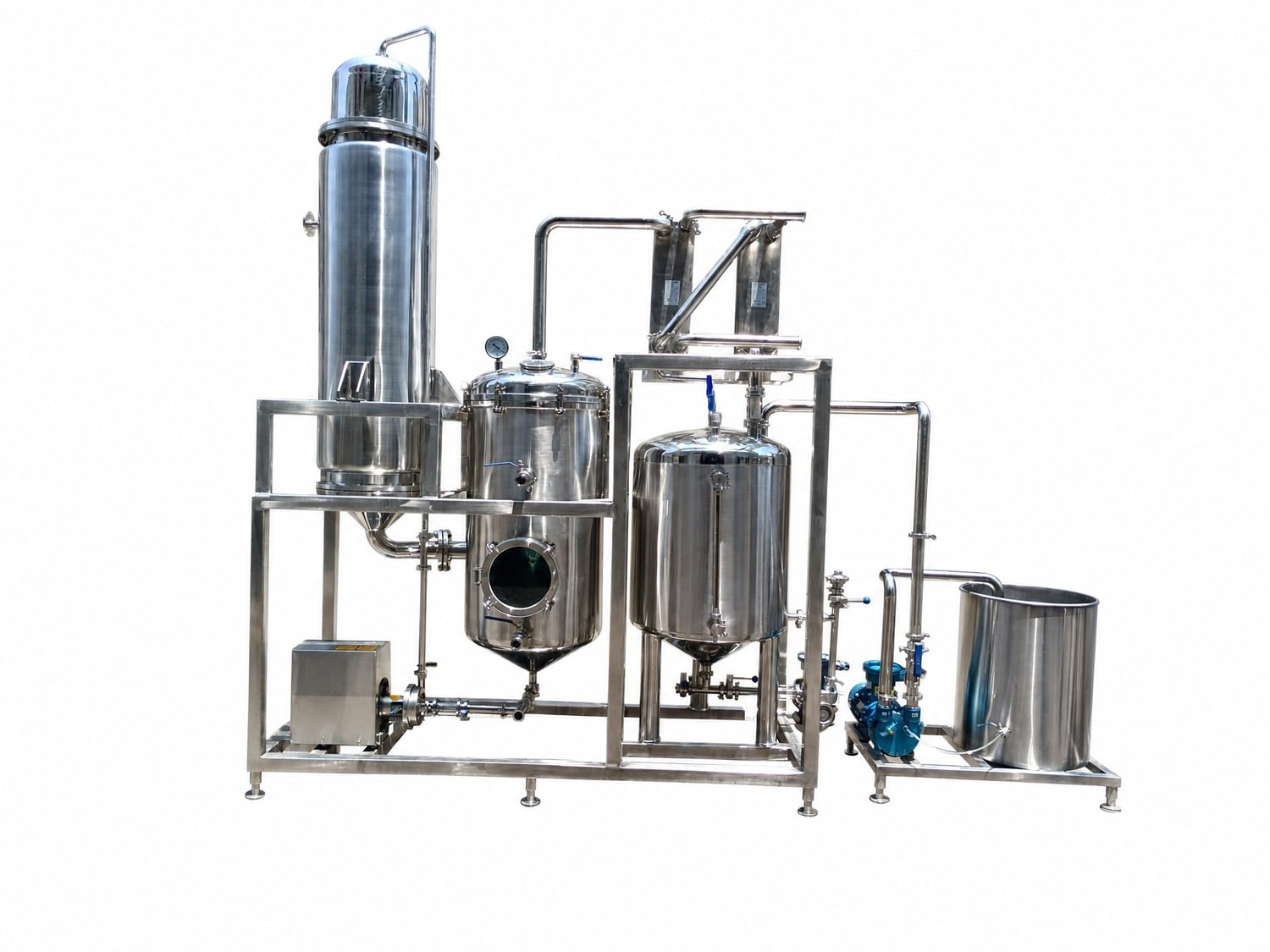
Figure 1. A falling film evaporation train on its skid: vertical evaporation column, service and separation vessels, and the sanitary pipework that links the stages.
A falling film train is more than a heated column. These are the parts that determine whether it performs as designed once the feed changes.
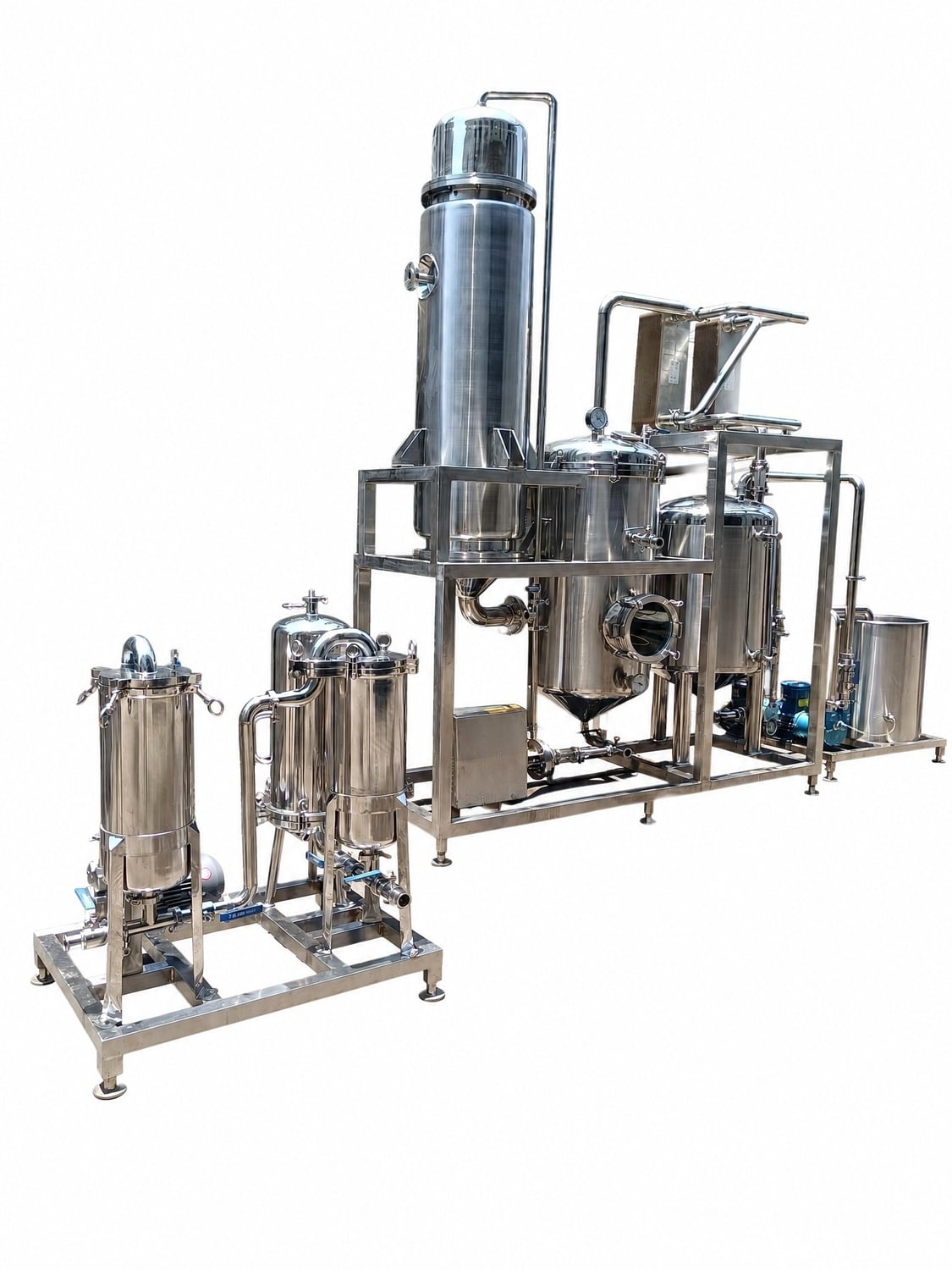
Figure 2. Vessel head with sight glasses and pressure gauges on the separating vessels; the two-housing filtration module sits in the foreground.
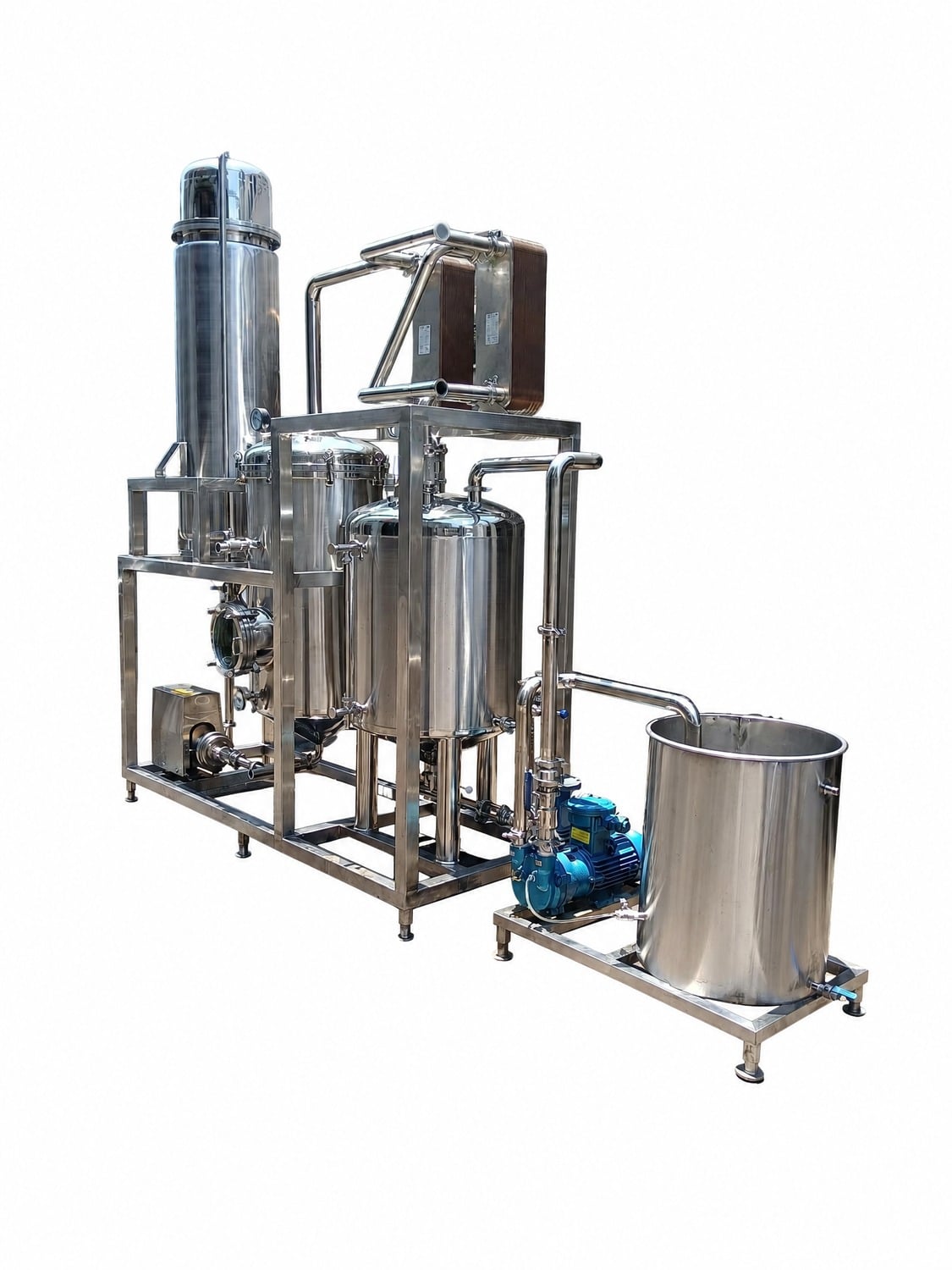
Figure 3. The same train from the drive end: heat exchanger on the column head, product pumps and the collection vessel on the skid.
|
Question |
Why it changes the design |
|
Feed flow rate and inlet solids |
Sets the evaporation load and the size of the first effect |
|
Target outlet concentration |
Determines how much water must be removed, and therefore how many effects are economic |
|
Maximum temperature the product tolerates |
Sets the vacuum level and, with it, the temperature difference available across the train |
|
Viscosity at outlet concentration |
Decides whether a pure falling film will wet the tubes evenly or whether a forced-circulation stage is needed |
|
Scaling, crystallising or foaming tendency |
Decides the tube surface, the cleaning strategy and whether falling film is the right family at all |
|
Available utilities |
Chooses between multi-effect, TVR and MVR more than any other single input |
|
Material of construction |
304 or 316L for most food duties; higher alloys where the product or the cleaning chemistry demands it |
|
Automation and records |
Manual, PLC or recipe-logging control, matched to the batch record the destination market expects |
Q: What is the difference between a falling film and a rising film evaporator?
In a rising film unit the liquid and vapour travel upward together, so the vapour has to push through the liquid column. In a falling film unit the product runs down the inside of the tube as a thin film with the vapour, which shortens residence time, lowers the temperature difference needed and tolerates more viscosity.
Q: Can a falling film evaporator handle a viscous product?
Up to a point. As viscosity rises, the film becomes harder to keep continuous and the risk of dry patches grows. Beyond that point the usual answer is a forced-circulation stage after the falling film, rather than accepting a badly wetting film.
Q: Why does capacity fall away over a production campaign?
Almost always fouling somewhere in the train, and often it starts with the feed distribution rather than the product itself. If the distributor is not feeding every tube evenly, the starved tubes foul first and the loss of surface area shows up as falling capacity.
Q: Is MVR always cheaper to run?
No. MVR shifts the cost from steam to electricity, so it wins where steam is expensive or unavailable and the electricity tariff is favourable. It also carries compressor capital cost and maintenance. The comparison belongs in the design stage, with your actual utility prices.
Q: What vacuum level do I need?
That follows from the maximum temperature your product tolerates, not from a standard figure. Once the temperature limit is known, the vacuum level is determined by the boiling point of your liquid at the concentration you are reaching.
Q: Can one unit concentrate several different products?
Yes, when it is designed for it: a drainable layout, effective CIP and recipe-based control are the enabling features. What you are buying in that case is changeover speed and repeatability rather than a single fixed duty.
If you are planning an evaporation project, four inputs are enough for us to come back with a usable proposal: feed flow rate and inlet solids, target outlet concentration, the maximum temperature your product tolerates, and the utilities you actually have available. Shanghai Ruiyuan Machinery will respond with a stage-by-stage arrangement, a recommendation between multi-effect, TVR and MVR, and a quotation for the scope you need - a single effect or a complete train.
Article prepared for the Ruiyuan Machinery international site and independent website. Arrangements described are configurable; final process guarantees are confirmed per project.

Shanghai Ruiyuan Machinery Co., Ltd. is a high-tech enterprise specializing in complete production line projects and laboratory equipment for the food, dairy, beverage, biotechnology, chemical, and pharmaceutical industries.
 EN
EN