Fill a jam kettle with strawberry purée, switch on the steam and walk away for an hour, and you will get jam. You will also get a dull brown-red colour, flat aroma, a wall of scorched fruit welded to the jacket, and a cleaning shift nobody wants. The problem is not the recipe. The problem is where the heat meets the fruit.
A scraped-surface vacuum concentration tank solves both halves of that problem at once: it pulls the boiling point of the fruit mass down to roughly 45-60 °C, and it keeps the heated wall wiped clean on every single revolution so the product never sits still long enough to burn.
This article explains how the two mechanisms work, what changes in the finished jar, the standard parameters of our RY-GBNS / RY-ZN series, and how to size a unit for your own product.
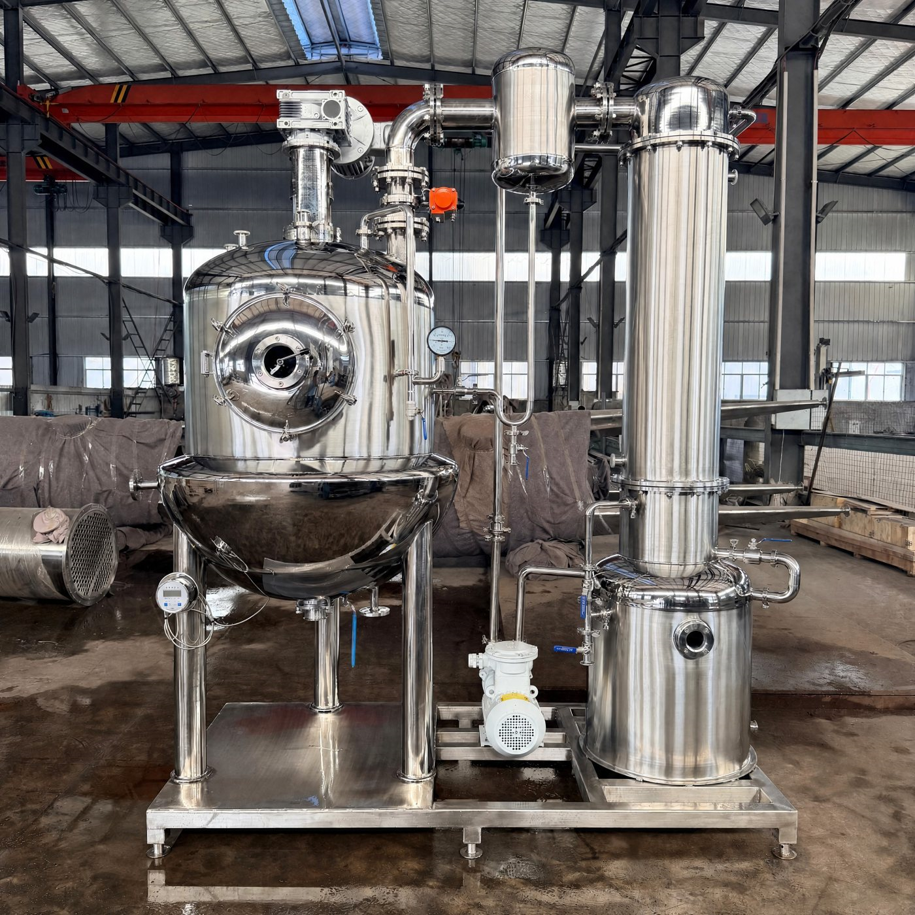
Skid-mounted scraped-surface vacuum concentration tank with jacketed vessel, scraper drive unit, condenser column and distillate receiving tank
Why jam is the hardest product to concentrate
Most evaporators are designed around clear, free-flowing liquids. Jam breaks three of their assumptions at once.
It is thermally fragile. Anthocyanins in strawberry, raspberry, cherry and blueberry degrade quickly above 80 °C. Pectin - the thing that makes jam set - depolymerises under prolonged heat. Aroma volatiles, the compounds that make people say "this tastes like real fruit", start leaving the moment the mass boils hard. Hold a fruit purée at atmospheric boiling temperature and you lose all three, permanently.
It is viscous, and it gets more viscous as you go. A fruit purée enters the tank at maybe 12-20 °Brix and leaves at 65-68 °Brix. Over that range the viscosity climbs by orders of magnitude, until the mass behaves less like a liquid and more like a paste. Pumps, pipes and conventional falling-film surfaces simply stop working.
It fouls the heated wall. In any jacketed vessel a stagnant boundary layer forms against the hot metal. With water that layer is thin and harmless. With a sugar-rich fruit paste it thickens, overheats, caramelises and finally carbonises - a scorched film that insulates the jacket, slows the batch, taints the flavour, and has to be scraped out by hand. Burn-on is the single most expensive failure mode in jam production: it costs you energy, yield, colour and labour at the same time.
Two mechanisms that fix it: vacuum and a scraper that never stops moving
Lower the boiling point instead of adding more heat
Water boils at 100 °C only because it is sitting under one atmosphere of air. Remove that pressure and the boiling point falls steeply.
|
Absolute pressure |
Vacuum (gauge) |
Water boils at |
What it means for jam |
|
8 kPa |
~700 mmHg |
≈ 42 °C |
Deepest vacuum; the gentlest option for colour-critical berries |
|
10 kPa |
~685 mmHg |
≈ 46 °C |
Best compromise for aroma retention |
|
20 kPa |
~610 mmHg |
≈ 60 °C |
Typical operating band for sugar-rich fruit mashes |
|
40 kPa |
~460 mmHg |
≈ 76 °C |
Medium vacuum |
|
60 kPa |
~310 mmHg |
≈ 86 °C |
Light vacuum, high-solids finishing |
|
101.3 kPa |
0 |
100 °C |
Open pan - colour, aroma and pectin are all at risk |
Two engineering consequences follow, and both of them save money:
Because dissolved sugar and pectin raise the boiling point of the solution, a 65 °Brix fruit mass boils a few degrees above the pure-water figure. That is why we quote the practical working window as 45-60 °C rather than the theoretical minimum.
Keep the heated wall clean on every revolution
Vacuum alone does not fix a viscous product. Lower the boiling point and the boundary layer against the jacket is still there, still stagnant, still overheating.
The scraper is what closes the gap. Inside the vessel, food-grade blades mounted on a central shaft rotate against the jacketed wall with a controlled clearance. On every pass they lift the film of product off the hot metal and throw it back into the bulk mass. The result:
The tank body geometry is matched to the product and to discharge requirements: a spherical body (GNQ) for even wall contact and smooth product flow, or a conical body (GNZ) for reliable draining of thick, pasty concentrates.
What is inside a scraped-surface vacuum concentration tank
The standard Ruiyuan configuration is built from five functional blocks, plus the drives and controls:
Around that core we add the vacuum system, jacket heating circuit (steam, hot water or electric), CIP spray ball, instrumentation (vacuum gauge, digital temperature display, sampling valve), and a control panel - from manual valves and digital indicators up to PLC + HMI with recipe storage and batch data logging.
Inside the vessel: the scraper blades sweep the heated wall on every revolution, so no stagnant film can form and nothing scorches.
Process video file: assets/web/scraper-wall-demo-h264.mp4
What changes in the finished jar
Standard technical parameters
The table below lists the standard vacuum concentration series. Sizes run from 10 L pilot units to 500 L production vessels; larger capacities and multi-effect or thermally recompressed layouts are engineered to order. Because heating area, condensing area and vacuum level all have to match the product, the final figures are confirmed against your purée, your target °Brix and your required evaporation rate.
|
Parameter |
Unit |
50 |
100 |
200 |
300 |
500 |
|
Nominal volume |
L |
50 |
100 |
200 |
300 |
500 |
|
Steam pressure |
MPa |
≤ 0.15 |
≤ 0.15 |
≤ 0.15 |
≤ 0.15 |
≤ 0.15 |
|
Vacuum (gauge) |
mmHg |
≤ 700 |
≤ 700 |
≤ 640 |
≤ 640 |
≤ 600 |
|
Heating area |
m² |
0.4 |
0.59 |
0.8 |
1.1 |
1.45 |
|
Condensing area |
m² |
1.2 |
1.7 |
2.45 |
3.0 |
3.2 |
|
Cooling area |
m² |
0.25 |
0.35 |
0.4 |
0.6 |
0.7 |
|
Receiving tank |
L |
15 |
45 |
60 |
76 |
100 |
|
Net weight |
kg |
~ 350 |
~ 450 |
~ 550 |
~ 650 |
~ 800 |
|
Dimensions (L x W x H) |
mm |
1200 x 600 x 2200 |
1350 x 750 x 2200 |
1700 x 800 x 2700 |
1700 x 1000 x 3400 |
2100 x 1200 x 3400 |
Parameters refer to the standard series and are subject to engineering confirmation for each product, viscosity and duty.
Options and customization
Applications
The same principle - low temperature plus a wiped wall - suits any fruit product that is thick, heat-sensitive, or both:
Fruit purée boiling under deep vacuum, seen through the inspection sight glass of a scraped-surface vacuum concentration tank.
Process video file: assets/web/jam-concentration-1-h264.mp4
How to size a unit for your product
Concentration is a mass balance, and the number that sizes the machine is not the batch volume - it is how much water you have to remove, and how fast.
Water to evaporate = M_feed x (1 - \frac{Brix_in}{Brix_out})
Worked example. 500 kg of fruit purée at 12 °Brix concentrated to 65 °Brix:
500 x (1 - (12) / (65)) = 500 x 0.815 = 408 kg of water
The batch finishes at roughly 92 kg of jam. Divide the 408 kg by the batch time you need and you have the required evaporation rate in kg/h - the figure that determines heating area, condenser size and vacuum pump capacity.
Send us these six inputs and we will size the unit and quote it:
Choosing between concentration technologies
|
Technology |
Typical boiling temperature |
Handles high viscosity |
Burn-on risk |
Best suited to |
|
Open pan / atmospheric steam kettle |
100 °C and above |
Moderate |
High |
Traditional cooked preserves where caramel notes are wanted |
|
Jacketed vacuum kettle with sweep agitator |
45-65 °C |
Moderate |
Moderate |
Medium-viscosity jams, small batches |
|
Scraped-surface vacuum concentration tank |
45-60 °C |
High, to specific gravity > 1.4 |
Low |
Viscous, heat-sensitive, high-fruit jams and purées |
|
Falling-film / forced-circulation evaporator |
45-70 °C |
Low - needs free-flowing product |
Low to moderate |
Clear juices and low-viscosity concentrates, large volumes |
|
Wiped-film (thin-film) evaporator |
45-90 °C |
High |
Low |
Continuous duty with very short product hold-up |
If your product pours like juice, a falling-film evaporator will concentrate it more cheaply per tonne. If your product sets in a jar, a scraper belongs on the jacket wall.
See the process running
A complete vacuum concentration train: concentrator body, condenser column, sight glass and control valves on a single frame.
Process video file: assets/web/jam-concentration-2-h264.mp4
Why work with Ruiyuan
Shanghai Ruiyuan Machinery Equipment Co., Ltd. has designed and built extraction, concentration and liquid processing equipment since 2011, from our works in Fengxian District, Shanghai. Our scope covers laboratory and pilot-scale units as well as industrial lines for the food, dairy, beverage, fermentation, pharmaceutical and fine chemical sectors: extraction and concentration plant, falling-film and single-effect evaporators, UHT sterilizers, crystallizers, spray dryers and complete turnkey production lines.
For concentration projects specifically, that means you are not buying a vessel. You are buying a unit that has been matched to your product's viscosity curve, your target solids, your utilities and your cleaning regime - and supported through installation, commissioning and operator training.
Frequently asked questions
What final solids can the unit reach?
The standard series is specified to concentrate to a specific gravity above 1.4, and viscosity - not vacuum level - is normally the practical limit. For most fruit jams that means 65-68 °Brix. Tell us your end point and we confirm the achievable figure against your product.
Will the scraper damage fruit pieces or texture?
The blades run against the wall with controlled clearance and wipe the heated surface rather than macerating the bulk product. Fruit pieces are usually added after concentration to keep them intact; where pieces must survive the cycle, we select the agitator geometry and speed accordingly.
Is the temperature low enough to protect pectin and colour?
Yes. The standard units operate at a gauge vacuum of 600-700 mmHg, which corresponds to a boiling point of roughly 45-60 °C for a sugar-rich fruit mass. That is well below the range where anthocyanins and pectin degrade quickly.
What utilities do I need?
Steam at ≤ 0.15 MPa (low-pressure or recovered steam is sufficient), cooling water for the condenser and cooler, and a standard electrical supply. Because the boiling temperature is low, the temperature difference across the jacket stays large, so a modest heating area does the work.
How long does a batch take?
It depends on the water you must remove and the evaporation rate sized for your unit. Use the mass balance above to get the kg of water, then divide by your required batch time - we size the heating and condensing area from that number.
Can it be cleaned in place?
Yes. Wetted parts are mirror-polished with rounded internal geometry, and CIP spray balls are fitted as standard. The scraper assembly is designed for routine inspection and blade replacement without major dismantling.
What documentation comes with the equipment?
Material certificates for wetted parts, fabrication and pressure test records, electrical and instrumentation documentation, and an operation and maintenance manual. Factory acceptance testing and operator training can be arranged before shipment.
Request a quotation
Send us your product, batch size, feed and target Brix, and your available utilities. We will come back with a sized unit, a process description and a quotation - and, where the recipe is new to you, we can run concentration trials on your own fruit purée before you commit to production capacity.
Contact
Tony Zhang
Shanghai Ruiyuan Machinery Co., Ltd.
No. 168 Qingling Road, Qinggang Park, Fengxian District, Shanghai, China
Mobile / WhatsApp: +86 136 0188 4162
E-mail: [email protected]
Web: www.ruiyuanextraction.com

Shanghai Ruiyuan Machinery Co., Ltd. is a high-tech enterprise specializing in complete production line projects and laboratory equipment for the food, dairy, beverage, biotechnology, chemical, and pharmaceutical industries.
 EN
EN